SubScribe Google+

Thursday, 5 September 2013

Life after death: the art of the obituarist


St Peter's cultural reception area will have been more crowded than usual after the skytrain from the British Isles pulled into the terminus this week.

Cliff Morgan, Seamus Heaney,  David Frost and David Jacobs were all in their seventies and eighties when they boarded that final shuttle - but who alighted? A rugby international or a broadcasting chief? A young satirist, a jet-setting talk-show host or a media entrepreneur?

It seems fair to assume that those whose earthly lives earn them admittance to the ultimate penthouse should not be required to spend eternity with the rickety joints and stilted gait that come with advancing years. The experience and wisdom acquired over a lifetime, yes, but in partnership with the physical and mental energy of youth. If there is a choice, I for one should prefer to be stuck at 28 or 38 rather than 58 or - if spared - 88.

Down here, it is the obituarist's privilege to determine at which point the clock should be frozen. A picture may be able to paint a thousand words, but finding one image to sum up an entire lifetime is a greater challenge. Take someone like Frost:, a man whose face has been familiar to most people in this country for the past half-century. His death made most of the front pages and in almost every case the photograph chosen had been taken in the past year or so. The Mail went for a slightly younger Frost - presumably on the basis that it was the best available picture of his wife - but only the Guardian looked back to the Sixties.

A figure such as Frost will always cause something of a tussle between the news and obits departments because there will have to be a potted life history up front as well as the inevitable 'tributes poured in last night to xyz, who has died, aged xx.'  And with someone who has lived almost their entire life in the public eye, there will be no shortage of pictures. Without disciplined picture editing, a page really can be spoilt for choice.


The Telegraph ran the story across the top of pages 2 and 3, with the Nixon interview photograph in the centre across the gutter. The intention may have been to make it the focus of the montage, but the monochrome picture is overshadowed by the shot of Frost and his wife at Ascot and the strange assortment of surrounding images. They don't tell a story and the pictures have been sized to fit a grid without proper consideration of their content.

The sofa picture of the TV-am crowd top right is full of character and brings back memories of the Eighties, but it's a ridiculously small slot for the Famous Five. We are also reminded of his old flames - Diahann Carroll, who dumped him virtually at the altar, and Lynn Frederick, to whom he was briefly married. Now here he is in the Sixties with Paul McCartney and there with Mrs Thatcher with her face split in two - is the picture supposed to echo the one of Nixon above? And to top it off, an utterly pointless picture of Frost with the Goldsmith women. Has the Telegraph still not got over its Jemima fetish? Nothing from ground-breaking That Was The Week That Was, nothing from the Frost Report. There is, however, a postage stamp of Frost and family at Buckingham Palace after he was knighted in 1993.


The obits page is far better with a portrait similar to the one used on the front of the Times, Frost (looking astonishingly like Michael Sheen looking like Tony Blair) with Nixon and our first view of the man as the host of TW3.


Most papers joined the Telegraph in going for montages inside - with rather too many clumsily splitting pictures across the gutter. The Mail, generously giving Max Hastings two bylines, focused on the family in the first of two spreads, and the socialite interviewer on the second. The Petula Clark picture is an odd choice for a main image - her legs perhaps? - but the end result is better composed and more easily navigable than the Telegraph's. There is nothing  from the earliest years but, for today, the Mail is forgiven almost everything for unearthing this gem from 1968, which deserves a bigger show:


Of the rest, the Express went in for shameless self-promotion, while the Guardian and Independent both opted for a small collection of pictures on the news pages with a strong portrait to illustrate the obit. The Guardian's captioning was the most helpful with the simple device of putting the year first.
             

My favourite combination came from The Times, whose uncluttered coverage managed to span the key points of Frost's 50-year career in six pictures. I particularly liked the use of the class sketch cutout of John Cleese, Ronnie Barker and Ronnie Corbett as that, more than anything, tells you straight away what the Frost Report was about. We also have a picture of the entire TW3 gang, portraits from two eras and a couple of the Sheenalike Frost with Nixon.  My only quibble is that, with the exception of Millicent Martin, it's a mite too male; a photograph of Frost and Lady Carina might have helped.


Ian Brunskill, obituaries editor at The Times, explained the balancing act: 

'There is no hard and fast policy, just that rather unsatisfactory process of finding what we hope is "the best pic". With less-than-public figures, it's often a case of making the best of whatever we can get from family or friends. Given more choice, there's obviously a strong case for using pics of people in their prime, if only because that's generally the period of the life that the obit will focus on. That was what we did with Frost - that main obit picture seemed to sum up his personality at the time of his greatest impact, as described in the piece.

Personally, I think that characterful older faces can make for very striking pictures and with someone who has lived to a great age or had one of those lifelong careers, I've often been inclined to go with something older. The present editor is a very firm believer in younger/prime pix every time, so that's the way we'll go whenever we can.'

The philosophy was seen in practice at the weekend with the death of Cliff Morgan, who started out as a rugby player, became a consummate broadcaster and rose to become the BBC's head of outside broadcasts and sport, overseeing coverage of the Olympics, the Queen's Silver Jubilee and the Charles and Diana wedding. A picture of an executive in a suit - or sports jacket - in front of a microphone or wearing earphones s never going to be as appealing as one of a fit young man, so it is unsurprising that most papers went with pictures from his playing days.

But Morgan (who happened to share a birthday with Frost) retired from the game 55 years ago, which means we are presented with an unfamiliar image of a familiar face. This works only if paired with a more modern picture somewhere on the page as a point of reference. There is also the fact that photographers worked in black and white in the Fifties.  Can a mono picture hold up a page of grey type, given that the obits pages tend not to go in for the whistles and bells  that we see in the news section?


We can see from this quartet that it can and does - but it needs to be given room to breathe. The colour picture in the Times seems static. The Telegraph, bottom right,  has a clear shot of Morgan, ball in hand, which ought to count as the perfect obit photograph, but there is more dynamism in the picture chosen by the Guardian and the Independent. The Independent has tried to cover both bases by pairing it with the armchair portrait, but it loses the drama of the game that we can see in the Guardian's version. 

The Mail and the Telegraph both chose that picture for their sport spreads - each of them splitting it over the gutter. The Mail also managed to dig out a really old picture and some really old words  - the late Ian Wooldridge's review of  Morgan's autobiography - for the news pages. Quite why it had to turn the death of a much-admired public figure into an assault on the BBC is hard to fathom. It's hard to imagine that Morgan will have held a grudge for 15 years after being taken off air prematurely.


Morgan obviously found his way into most sports sections and the natural choice for these pages would be the action shots. But the Independent, above, went completely left field with a straight portrait of a man in later years with half his head chopped off. There was also a double with a repeat of the obit photograph.


For David Jacobs all four broadsheets turned to the archive, two to the Fifties DJ era and two to the later years of the suave man-about-town. They all have charm and that smile has an impish aura that clearly never faded. Seeing the four together demonstrates that whatever the setting and whatever the age of the subject, a good photographer can capture the essence of a person in a single frame.

Harry de Quetteville, the Telegraph's obituaries editor, says his objective is 'absolutely to get a picture of someone in their prime'.

'The Pope is the one person where we would definitely go for a big picture of an old man, because that is how people know them.

Sometimes it is hard to get hold of what we want, so we are stuck with pictures of people in old age. But with people who have spent years in the public eye, we can use several pictures showing the evolution of a career. With David Frost we could go from the fresh-faced graduate straight out of Cambridge to the elder statesman of broadcasting.

When Michael Jackson died we ran three photos of him side by side from the black boy with the Afro hairstyle to the almost white adult with the delicate nose. Practically everything about him had changed.

With David Jacobs we could have done something with his early life and later career, but we decided not to do that - we thought the one big photo did the job. Unless you are stonkingly famous, one good photo usually does the job.'


I'm not sure that the photograph above meets the 'in his prime' criterion, but few papers covered themselves with glory when Seamus Heaney died. Here we had the passing of a  literary giant, but half of our Press didn't seem to care. Because he was not British? Or because he was Irish?

The Mail's first mention of his death came on page 33, and even there, Heaney wasn't deemed worthy of a full page - he had to share the space with a house ad. The Express did at least manage a page 2 teaser to its obit on 39. The Telegraph's news coverage was confined to a double-column page 13 lead over a 25x4, and while the Times did manage to put him on page 4 - it was halfway down the page. Pride of place at the top was surrendered to a puffy bit of country house and garden porn.


There was never any hope of a mere Nobel laureate making the front page in these four papers with the Duchess of Cambridge appearing in a pair of skinny jeans that she had - heavens alive - worn before she was pregnant.

The obituary pages are a bit of a law unto themselves, though. And long may that continue. It is here that you can find fantastic writing and the most amazing life stories - look at this one in the Telegraph today for example. This is the place where we can find the diamonds of the newspaper world, surrounded by the grey carbon of thermal underwear ads, lonely hearts and racecards. Here, at least,  the Telegraph and the Times teams realised the significance of Heaney's passing.


But the stars of the show were the Guardian and Independent. Both devoted the top half of their fronts to Heaney. A foreign poet. On a Saturday. With a war brewing. Hurrah. 


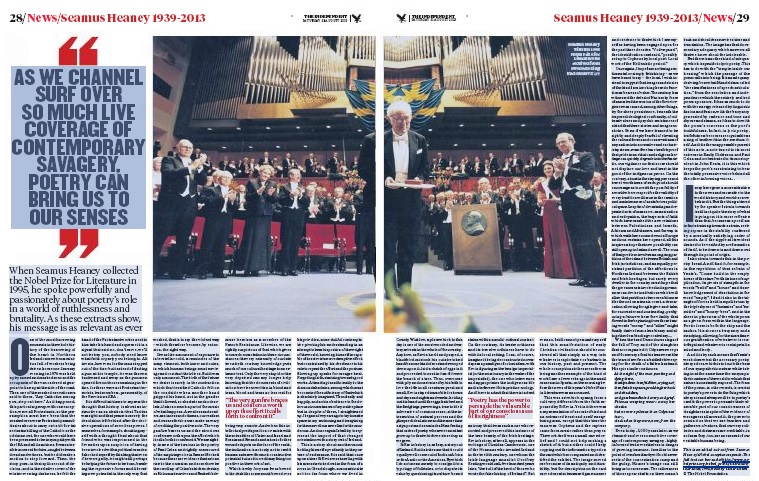
The Guardian had secured Colm Toibin, whose piece started on the front and continued on the whole of page 3. This was complemented by a full-page obit. The Indie gave the poet three spreads: pages 2 and 3, which featured a photograph of Heaney as a 30-year-old nursing a pint in a pub, the obit and the piece de resistance, his Nobel acceptance speech across 28 and 29, below. Unless I am mistaken, it was also the only paper to print a Heaney poem. Copyright issues can be tricky - and pricey. So hats off to the most poverty-stricken paper on the street for paying up and serving its readers well. True style.

This august quartet from England, Wales and Ireland were sadly joined on the skytrain by another literary great from Scotland. Alan Hamilton, the Times's appropriately titled Special Writer and royal correspondent, died last Friday aged 70. He was accorded an obit in his own paper and in the Telegraph. A youthful or mature photograph? A mature man relaxed in retirement. But this gentleman of letters never changed. He was magnificent at every age. 


And finally, SubScribe set itself a challenge. Was there anybody with a public career spanning a lifetime whose whole life could be told in a single photograph. Certainly not the Queen, nor Paul McCartney. No sportsman or actor. But I believe there is one person for whom it could work.
If you have other ideas, please share them. 


Wednesday, 28 August 2013

Syria: how the Press helped to put the brakes on bombing bandwagon


 Updated Thursday, August 29
  
Moreton Morland's view in The Times today

There is a strong chance that American air forces will be bombing Syria by the weekend.   There is also a strong chance that this desperate pitch for peace could again end up embroiling the West in another country's war.

America, Britain and France all stand ready to punish President Assad for a deadly chemical weapons attack last week and there has been much talk in the past couple of days of their 'moral duty' to act, with or without UN backing.

David Cameron yesterday chaired a meeting of the National Security Council, which he said had unanimously backed action against Assad and considered potential strategies. Today he will address MPs who have been summoned from their holidays to debate the possibility of air strikes.

He had hoped that this session would give him the authority to join the American action - but that idea was scuppered by Ed Miliband yesterday afternoon, an event that not only reduced the risk of an immediate war but also demonstrated that Malcolm Tucker's alter ego is alive and well and working at Tory Central Office.  Tucker manque brazenly described Miliband as a f****** c*** and a copper-bottomed s***.

Until yesterday the wheels on the bombing bandwagon had been turning ever faster as it hurtled down the hill to conflict,  Tony Blair cheering it on from his Mediterranean yacht. When Ban Ki-moon stepped into its path  like a latter-day John Lennon chanting 'All we are saying is give peace a chance', he seemed more likely to be mown down than to bring it to a halt. But, amazingly, he did at least manage to slow it down.

UN weapons inspectors have been in Syria since Monday and have examined the site of last week's attack. That they are in the country at all is a result of pressure on President Assad and they have more work to do before they can determine what caused the deaths. They are expected to be ready to report next week.

Many are questioning why, after two years of inaction, it has suddenly become so urgent to attack Syria now, this minute. Russia has mocked the West for behaving like a monkey with a hand grenade. What harm would it do to wait a few days? But until last night, there seemed little hope of convincing anyone in power.

These are serious times and the echoes of Iraq are everywhere - right down to the pleas that UN weapons inspectors be given time to do their job. So what have the papers made of it?

This is not the first time that chemical weapons have been used in Syria, but the attack last Wednesday was in Damascus and Assad's forces were immediately in the frame as the perpetrators. Up to 1,300 people were said to have been killed - many of them children.


The story led the Guardian, Independent, Times and Mirror on Thursday. A photograph of a man leaning over a baby among white-shrouded bodies was the most widely used image, but the Mirror's front was the most dramatic with a photograph of nine dead children who look as though they have been safely tucked up in bed for the night.

The Mail devoted an inside spread to the atrocity, as did the Telegraph, which also found room for it downpage on the front under a three-col picture of a beautiful woman who had had a leg amputated after being knocked down by a New York taxi.

With the sun shining for the bank holiday break - interrupted by flooding on Saturday - there were obviously more pressing concerns for some, but most papers have adopted a serious tone. The Mail, Mirror and the i joined the Times, Guardian and Telegraph in splashing on Syria on Bank Holiday Monday and even the Sun gave it a presence on the front.

The Indie took the conflict off the front on Tuesday, and the Mail pushed it back yesterday, but the Times, Guardian, Telegraph, Mirror and the i have been relentless.


For most of the week no one seems to have doubted that there was an attack of some sort that had killed 1,300 people - although the Guardian was cautious in its Thursday splash head, which referred to 'an apparent gas attack' - and Assad was assumed to have been behind the massacre.

The Obama Administration appeared confident on Tuesday night that it had proof both that chemical weapons had been used and that Assad was responsible for deploying them. Such proof could be said to legitimise military intervention under the 1925 Geneva convention. It would also allow the UN to justify action under its R2P - responsibility to protect - rules. These rules were were established after its peacekeepers stood by while Bosnian Muslims were massacred in Srebrenica.

It is rare for accurate casualty figures to emerge on the day of any disaster, no matter how many reporters and trusted sources there are on the ground. So the 1,300 could never have been a reliable number. Medecins Sans Frontieres, which has been working with hospitals in Syria, has said that about 3,600 people were affected, of whom 355 are known to have died.

Thus the deaths of 355 people in a civil war that has killed at least 100,000 are to become the tipping point: the end of the tutting and the 'something must be done' muttering; the start of a dangerous venture into the unknown.

President Obama is expected to show his hand today. Cameron, William Hague, John Kerry and Chuck Hagel are singing the Moral Chorus in four-part close harmony - which is just as well, since there is no orchestra or backing choir in sight.

Polls suggest that 60 per cent of Americans and up to 75 per cent of Britons are against any kind of military intervention. The only surprise there is that American antipathy isn't greater.

Nor is the British Press humming along. Every national paper ran a leader on Syria yesterday, but only The Times offered Cameron anything like the kind of support he would have wanted.


Coverage over the past two days has been thorough.  The Independent, for example, gave the story a splash, five inside pages, plus a leader and an oped yesterday and similar space today. Barely a tree has been spared to ensure that there is enough newsprint to examine the case for war - and still plenty to spare for Miley Cyrus and Catherine Zeta-Jones.

It was serious, restrained stuff. The Sun and the Mirror may have stuck with the tabloidese that insists on 'ammo' and 'tyrant' even when there's room for 'ammunition' and 'President', but there was no jingoism, no 'We're off to war to save the world'. Ten years after Iraq, at least some lessons have been learnt.

The Independent built on its Heir to Blair splash yesterday by looking at the parallels between Iraq and Syria: was intervention legal, were weapons inspectors given enough times, was Parliament properly consulted, was public opinion behind action and was Britain behaving like America's poodle.

Steve Richards draws further parallels on the leader page spread today, while the news pages carry an analysis by Patrick Cockburn of the threat to the rest of the region and a big-name voxpop.


The big names have been out in force across the Press - Tony Blair in The Times, William Hague in the Telegraph, David Owen in the Mirror, Hans Blix in the Guardian to name but four. Then there are the military experts, the clergy, not to mention the everyday pundits.

Nearly everyone has predicted that there would be up to 48 hours of cruise missile attacks in an 'arm's-length assault'. But then what? Syria isn't going to roll over. As the Syrian foreign minister Walid al-Muallem, quoted in the Telegraph, said:

'We have two options: either to surrender or to defend ourselves with the means at our disposal. the second choice is the best. We will defend ourselves. We have the means to defend ourselves and we will surprise everyone. The strike will come and go. We get mortars every day and we have learnt to live with them.'

In the Independent, Kim Sengupta wrote that General Martin Dempsey,  chairman of the US Joint Chiefs of Staff, had said that air strikes 'would not be militarily decisive, but would commit us decisively to the conflict'.  Sengupta also reminded readers of the laws of unintended consequences and painted various scenarios that could make things even worse for ordinary Syrians.

There was not even consensus on the objective of airstrikes. Obama may have a vision of a future Syria that is 'peaceful, non-sectarian, democratic, legitimate and tolerant'.  But even I can see that that won't be achieved by a weekend of bombings.

Some papers believe the intent is to force Assad to a new round of Geneva talks - that when he realises the American ships in the area aren't there just to take in the sun, he will see reason. Er yes, he's bound to with a Russian missile cruiser and anti-submarine ship steaming towards the Med.

We have also heard the dreaded phrase 'regime change'. To what? The 'rebels' are no longer the ordinary protesters who set out to secure democracy during the Arab spring two years ago. They are now, as Robert Fisk points out in the Independent, backed by Al-Qaeda, raising the bizarre notion that America and the terrorists behind 9/11 could find themselves on the same side.

And what would be the targets of these air strikes? Again, all the Press could do was speculate. Roger Boyes in The Times yesterday went through five possibilities. These range from a simple show of force that could lead to peace talks to attacks on helicopters and Scud missile sites that could lead to all-out war. It made sober and sobering reading. Today he is more forthright in saying that 'clinical' airstrikes are less than useless and that the only feasible objective of any action is to get rid of Assad:

'So here is what is missing from the decision to use “stand-off” weapons against Syria: a determination to confront an evil regime. In my old-fashioned view, you either go to war, or you don’t. 
Cruise missiles cannot be used as a kind of high-tech pigeon post to send messages to dictators set on killing their own people. If you punish Assad without defeating him, the only message he will understand is that he remains invincible. That is how it will look from the President’s underground hideout. 
The goal has to be to topple Assad.'


His colleague the recently ennobled Danny Finkelstein argued that that the fact we don't know how what air strikes might lead to is no reason to do nothing. In his view, inaction is not an option, whereas by doing something Assad may be forced to talk:

'No one can be certain that acting will produce this outcome or that the outcome will be desirable. No one can say for sure what the end game is. Once we start the whole thing is open-ended. But the point is that if we don't start it is open-ended too, and no one knows what the end-game of that inaction is either.'

On the other hand, Seamus Milne in the Guardian saw no possibility of any good coming from airstrikes. He urged the West to seize the moment to give the UN the authority and backing it needed to secure chemical weapons dumps. But he was not hopeful and concluded:

'Even if the attacks are limited, they will certainly increase the death toll and escalate the war. The risk is that they will invite retaliation by Syria or its allies - including against Israel - draw the US in deeper and spread the conflict. The West can use this crisis to help bring Syria's suffering to an end - or pour yet more petrol on the flames.'

Ah yes, Israel. Hezbollah. It's frightening. Israel, which has been asked to keep quiet, can probably look after itself if it comes under attack. But what of the rest of the region?

The Arab League has said that it is convinced that Assad was behind the attack last week; Turkey agrees that Syria should be punished. It has some defences in case of retaliation, but Jordan, which is seeing a stream of refugees fleeing the conflict, has a way to go, even with the allies offering reassurances that  it will be protected.

Few need telling that one false move in the Middle East could lead to conflagration, but how many understand the intricacies of the relationships between the countries? The Sun should be congratulated for its attempt to spell out the various positions in this series of factboxes.


The Sun, Guardian, Independent and Telegraph leader writers all counselled caution yesterday, mostly with a strong hint that military action might not be a great idea. The Mail and Express went further. The Express editorial, headlined An entirely inappropriate use of our military power, pointed to the rebels' Al-Qaeda links and urged MPs to vote against air strikes.

On the same page the political commentator Janice Atkinson wrote that Blair's intervention should be enough to convince anyone that bombing Syria was not a good idea: 'Putting Blair in charge of the Middle East is like putting Harold Shipman in charge of the elderly.'

Stephen Glover on the Mail's leader page was even harsher. Under the heading 'This warmonger is the very last man we should listen to'  he wrote:

'Here is the wild-eyed Tony who once told a Labour Party conference that he would re-order the world. "From the threat of the Iraqi regime to the pulverising of Syria," he declares, "to the pains of the Egyptian revolution, from Libya to Tunisia, in Africa, Central Asia and the Far East, wherever this extremism is destroying the lives of innocent people, we should be at their side and on it."
'Golly, Tony Blair is going to have us fight a lot of wars all over the place.'

The second leader alongside the Glover piece was equally appalled:

'Isn't it hard to imagine any more dangerous advice from this perma-tanned fantasist - the incongruously styled Middle East peace envoy - who led Britain to war in Iraq on a lie?
Indeed it is precisely because Mr Blair so fatally undermined public trust in the Prime Minister's office that it is vital for MPs to scrutinise all the facts before we blunder into another bloodbath.'

Don't you love newspaper style that allows the leader writer to describe a former Prime Minister as a perma-tanned fantasist yet requires that he keeps his honorific.

Today the Mail follows up with a full-page leader telling MPs that if they have the slightest suspicion that airstrikes would cause more suffering than they could prevent, then they have a moral duty to vote no. It further questions what makes Syria different from other conflicts from which we have stood aloof, such as those in Zimbabwe, Congo, Darfur, and quotes an uncomfortable sentence from the Spectator over the distinction of using chemical weapons:

"We are, in effect, asking Assad if he would please kill his enemies using conventional means.'


It is just possible that, for once, the restrained approach by the Press managed to restrain the politicians. Perhaps emboldened by the public aversion to military action and the executive-chair generals' words of warning,  Ed Miliband called the Prime Minister yesterday afternoon and said he could not guarantee Labour's support in the Commons today.

Within a couple of hours, Britain had submitted a draft resolution to the UN, Cameron had agreed that no action would be taken before the weapons inspectors had reported, and MPs were promised two votes - one today and one at a later date - before Britain became involved in any attack on Syria.

Almost as quickly the story became, for the Press, an old-fashioned Westminster tussle instead of hand-wringing over the fate of people they don't really care about. The trusted words and phrases came bouncing back: 'mutiny', 'humiliating climbdown', 'forced into retreat', 'back from the brink'. The politicos could write the inside story of the comings and goings, how Miliband's stock has risen. And all just before the party conferences. Happy days all round - for now.


No one wants Assad to gas anyone, and certainly not his own people, any more than they did when Saddam Hussein attacked the Kurds, But there is little public appetite for British involvement in another Middle Eastern conflict.

To put it bluntly, it frightens us. We are scared that if there is a third world war, it will probably start in the Middle East and we don't want to risk it.

The papers reflected that. Miliband took heed and Cameron recognised when he held a losing hand. The Americans may go ahead with the bombings at the weekend, but they will be without a faithful hound at their side - if you were so minded, you might think of it in terms of Dick Dastardly flying without Muttley.

Attacking Assad may eventually prove to be the right thing to do, but for now it is much-derided Fleet Street that has done the right thing. It has helped to persuade the politicians to pause and think.
It has cause to be proud.

And finally

Just for fun, here are some of the stories that challenged Syria when it came to choosing the splash this week. Assad obviously stood no chance against broccoli curing arthritis - and as for Gordon Taylor's debts, well.....


And even while reporting the imminent threat of war in the top lefthand corner, the Telegraph always has room for a picture of the Duchess of Cambridge on her way home from Waitrose, or a Hollywood marriage break-up. Well, it is still summer - just.


If you have the appetite for more Syria, you might enjoy these:


Please feel free to recommend more. There are bound to be many. Thanks for getting this far.


Thursday, 22 August 2013

David Miranda's detention matters to us all, not just to the Guardian

Miranda and Greenwald on Sunday. Photograph by Getty


The Guardian has never been the most popular player in the Fleet Street squad. The wiry leftwinger is capable of charging through the opposition to score spectacular goals, but it rarely finds itself in the middle of celebratory team hugs.

When the Telegraph was on a roll with MPs' expenses, every other night newsdesk was on alert for the website tasters and the first editions, ready to cut, paste, analyse and curse that they had  no control over the only game in town.

When the Guardian accused News International of phone hacking, it was largely ignored. Time and again it raised its hand and cried 'Look! Look!' But no one was remotely interested until Milly Dowler found her way into the splash heading. From that day the British Press was changed forever.

On Monday, the Guardian splashed on the detention of David Miranda as he was passing through Heathrow on Sunday morning, an event that aroused little interest in other papers. But we may yet look back on it as the day that changed Britain's terrorism laws.

Miranda is the partner of Glenn Greenwald, who has been writing for the Guardian on material gleaned from Edward Snowden, the runaway US National Security Agency whistleblower/leaker.

Miranda is Brazilian and the couple live and work in Brazil. He was held on a stopover on his way from Berlin to Rio de Janeiro and questioned by half a dozen agents for nearly nine hours - the maximum time allowed. He was denied access to a lawyer for almost all of that time and was even apparently denied a pencil and paper to note down what he was being asked. His laptop, phone, camera and memory cards were confiscated - along with a games console and a couple of DVDs - and he was then allowed to continue his journey.

All of this happened under Schedule 7 of the Terrorism Act, 2000. This piece of the legislation allows the detention of someone in the no-man's land of an airport or port solely in order to determine if they are planning or engaged in an act of terrorism. There is no requirement that there should be grounds for suspecting the person of being a terrorist, and questioning can cover all areas of the detainee's life.

It's worth pausing over that. Anyone returning home from a family holiday can be hauled into a room and interrogated like this - you, your Auntie Sal, the next-door neighbour.

The Guardian obviously has its agenda and the decision to splash on the story was unsurprising. The BBC, ITV and Sky were all equally exercised by the sequence of events as to give the story top-billing.

Over the past three days David Anderson, who is responsible for reviewing terror legislation, has called for safeguards to prevent abuse of these powers.

The former Labour Lord Chancellor Lord Falconer has said he believes that the detention was illegal.

Keith Vaz, chairman of the Home Affairs Select Committee, has asked for an explanation for the 'extraordinary use of anti-terror powers'.

Yvette Cooper, the Shadow Home Secretary, wants an investigation into whether the law was misused.

Conservatives, including David Davis, have also expressed concerns, although Theresa May has been robust in her defence of the police action.

We know that the Government told the US about plans to detain Miranda and that the Americans say that they did not instigate or request such action. We know that the Committee to Protect Journalists in New York has written to David Cameron asking for an investigation.

We have also learnt this week that Cameron, Nick Clegg, William Hague ordered the Cabinet Secretary to strongarm the Guardian over the Snowden material it already had in its possession and that GCHQ officials oversaw the physical destruction of computer hard drives in the newspaper's basement, claiming that information on them could find its way into terrorist hands.

Peter Capaldi, right,  as Rusbridger and Dan Stevens
 as Ian Katz in the film The Fifth Estate


The Guardian editor Alan Rusbridger has written that the hard-drive battering came after a series of telephone calls from 'shadowy Whitehall figures' who told him: 'You've had your fun. Now we want our stuff back', and 'You've had your debate. There's no need to write any more.'

And from where have we learnt all this? Well most of it from the Guardian, of course. A great deal from the internet, a fair chunk from the Mirror and the Independent, rather less from the Times, and next to nothing from the Telegraph, Mail, Express or the Sun.

The Telegraph was actually first off the mark with a six-par story on page 4 on Monday, which was clearly a late-edition catch-up as it is spattered with the tell-tale 'The Guardian reported...'
This was followed by slim page 10 hampers both yesterday and this morning.

The Times ran a page 11 lead on Tuesday and a leader that boiled down to 'Let's hope this was an appropriate use of these powers'; there was a further page 4 lead this morning. The Mail also made Miranda its page 4 today - a story that is almost entirely sympathetic to the authorities with a couple of pars of counter quotes at the end.

Whistleblowing, leaking, call it what you will, is not an activity that is of intrinsic interest to readers. These are the mechanics of journalism. Readers want the facts and they will then be the judge of whether the means of obtaining them were reasonable. There is a particular audience for stories about the Assanges, Mannings, Snowdens - and it is far from mainstream. That may explain why the Miranda story has been treated as almost just another episode in the Guardian's personal drama.

But it isn't.

Here we are in the post-Leveson era when restrictions on the Press should be at or near the top of every newspaper's concerns. It it right that 'shadowy Whitehall figures' should be telling a national newspaper editor that he doesn't need to write any more on any given subject? Well at least one writer - Jay Rosen - sees the danger, although not in British newsprint.


Even more important, is this another assault on the freedom of the individual - that right so cherished by the Tories who have defended the police action? Remember, any one of us could be subjected to the treatment handed out to Miranda on Sunday.

The FT ran a leader on Tuesday headlined Britain's botched use of terror laws. It went live on the website at 6.46pm on Monday and spoke of the treatment of Miranda sparking a 'huge outcry'.
A huge outcry by whom?

The Guardian, certainly. But by that time only the Mirror seemed similarly concerned. It ran a leader headlined Freedom at stake which described Miranda's detention as unjustified and concluded  'Silencing journalists keeps you, the public, in the dark.' On the same page Shami Chakrabarti, the director of Liberty, reveals how commonplace the use of Schedule 7 turns out to be. Muslims are so used to being questioned under this provision that they routinely build extra hours into their journey planning to account for it, she writes. She then cites this case:

'Liberty has a client who was detained in November 201 0 with his elderly mother after they had flown back to Heathrow via Bahrain.
He is British. He was detained for more than four hours. He was asked about his salary, his voting habits and the costs of his Hajj pilgrimage to Mecca.
They went through his possessions with a fine-tooth comb; they made copies of his credit cards; they kept his mobile phone and SIM cards which were only returned eight days later. 
This man had never in his life been arrested or detained by the police.'


Shami Chakrabarti. Photograph: Jewish Chronicle
According to the terror law watchdog David Anderson fewer than 40 people a year are detained for more than six hours under Schedule 7. The figure is put forward to show how unusual the treatment of Miranda was. The Mail goes to the opposite end of that spectrum, pointing out that 70,000 people per year are stopped in this way, as though to undermine the suggestion that Miranda - who was carrying encrypted Snowden material - suffered anything untoward or undeserved.

Whichever way you look at it, it's alarming. Either that such vast numbers are stopped and questioned going about their everyday business, or that someone who is clearly not a terrorist is held for so long without being allowed the advice of a lawyer.

An infringement of press freedom or of individual liberty? Surely it's worth the debate? Aren't these the questions our newspapers - at least the broadsheet tendency - should be asking? Yet most leave the questioning to general columnists rather than to specialists or leader writers.

Rob Crilly for the Telegraph website has a good old go at the Guardian before concluding that the whole episode is frightening when the threat to the individual is considered.

Matthew Norman in the Independent describes the case as sinister and an abundant disgrace. He points to Britain's desire to do - or to be seen to do - the bidding of the Americans and the resultant growing authoritarianism: 'The politicisation of the police becomes ever more entrenched.'

Stephen Glover in the Mail also sees Britain turning into a police state. But he has few tears to shed for Miranda, Greenwald or the Guardian. Instead he almost rejoices in the schadenfreude that the paper whose work led to so many journalists to be arrested should now expect sympathy when such traumas land on its own doorstep.

Glover is not the only one to point to the aftermath of the hacking scandal - Claire Fox also likens the Miranda detention to the post-Leveson arrests, reminding us in the Independent that many journalists have been on police bail for more than a year and that none has yet gone on trial. Online Brendan O'Neill of Spiked is vitriolic in accusing the Guardian of double standards, given its role in the News of the World saga.

It's an easy way to get at the Guardian, the unloved team member, the holier-than-thou paper that brought Leveson and all its horrors raining down on us and yet is now trading in stolen classified information. What's the difference in doing that and hacking into someone's phone? They're both illegal.

But that isn't the point. This isn't about the legitimacy or otherwise of using Snowden material. It is about whether an individual - journalist or not - should be detained and questioned about the minutiae of their lives when there isn't a scintilla of evidence to suggest that they are anything other than upright and honest. That is not, I'm afraid, the same as arresting and bailing or charging someone suspected of a criminal offence.

But that is only my opinion. It would be good to see people with full understanding of the law debating these issues in newsprint. Some hooe. Our papers haven't got as far as considering whether the use of Schedule 7 was legal. David Allen Green spells out his view on his blog, and attracts one of the most intelligent comment threads you'll read in a long time. But the papers have simply quoted Teresa May as saying it was and Falconer as saying it wasn't.

Without being rude to Glover, Norman and Fox, where are the really informative pieces by heavyweight experts? Nick Cohen writes trenchantly in a blog for the Spectator, but what about the dailies?

Where is the explanation of the law and how it came into being - after the Troubles and before 9/11?

Where is the examination of how its use in fishing expeditions can be avoided if police can stop anyone and require them to answer questions on limitless subjects?

Where is the analysis of the tens of thousands so stopped?

Where are the case studies, the examples of those Muslims who have to allow extra journey time to compensate for that lost in interrogation?

Where are the numbers and case studies of terrorists apprehended or deported as a result of Schedule 7?


We have the Prime Minister, his deputy and the Foreign Secretary approving the destruction of a newspaper's computer hard drives - a situation the White House said it could never envisage - and yet the political editors and commentators are silent.

And the tech writers? In the face of cries of 'how could you acquiesce?' Rusbridger pretty well states that this was all just pantomime nonsense - how many spooks does it take to smash up an Apple Mac?

 The material wasn't lost to the Guardian, there are copies safely stored outside of the country. But was the Government right in suggesting that the computer network was not sufficiently secure and that dangerous information could get into terrorist hands? What sort of encryption systems are necessary to make our computers safe? Indeed, given Whitehall's record on computer security, is the Government in any position to cast aspersions about anyone else's gatekeeping?

But no, the mentality appears to be 'It's just the old Grauniad on one of its hobby horses. Nobody reads it anyway. Why should we care?

We should care because it is an important issue of individual and Press freedom versus state control and authoritarianism. And the biggest journalistic stars should be playing out that match in front of a capacity crowd - in print.


SubScribe

@gameoldgirl